
The EU ELV Regulation and Recycled Plastics: What OEMs and Compounders Need to Do Now
After more than two decades, the EU’s End-of-Life Vehicles Directive has been replaced by a directly binding Regulation. Following the political agreement reached in December 2025, the ELV Regulation (ELVR, Regulation (EU) 2026/1738) was formally adopted. It was published in the Official Journal of the European Union on 24 July 2026. The new framework represents one of the most consequential shifts in automotive materials policy in a generation.
Its implications extend well beyond vehicle dismantling. They reach into the sourcing and material specification decisions being made today. Companies that start building traceable material supply chains now — together with partners they can rely on — will be better positioned as the Regulation’s requirements take effect.
The Council’s full press release on the agreement is available on the Consilium website.
What Are the Recycled Plastic Requirements in the EU ELV Regulation?
Mandatory recycled plastic content targets
The centrepiece of the new framework is a set of binding recycled plastic content requirements for new vehicles:
- 15% recycled plastic content per vehicle within six years of the Regulation entering into force
- 25% recycled plastic content within ten years
- At least 20% of that recycled content must come from materials recovered from end-of-life vehicles or used vehicle parts (the so-called “closed-loop” recycling stream)
Design and documentation requirements
Beyond content targets, the Regulation also requires that vehicles be designed for easy dismantling, and that they meet defined reusability, recyclability, and recoverability rates. The Regulation introduces extensive digital information and traceability requirements throughout the vehicle lifecycle. These requirements support transparency in material flows and circularity reporting.
Extended scope
The Regulation extends treatment requirements, including collection, depollution, and mandatory part removal, beyond passenger cars to heavy-duty vehicles for the first time.
Why Is ELV Compliance Challenging for OEMs and Compounders?
Meeting these targets is not straightforward. The automotive supply chain is still building the processing infrastructure and material volumes needed to meet these requirements at scale. Regulators have acknowledged this by building transition timelines into the framework, but the direction of travel has not changed.
A further complication is the current lack of finalised compliance methodologies. The Commission is expected to adopt detailed methodologies for calculating and verifying recycled plastic content. These should provide greater clarity on how compliance must be demonstrated. Until those definitions are established, businesses face some uncertainty about exactly what conformity will require.
The direction of travel is clear: circularity at scale, across increasingly complex material flows, is where automotive manufacturing is heading. The businesses that move early on verified material relationships — while there’s still room to test and get it right — will be better placed when the deadlines arrive.
What “Closed-Loop Recycling” Means for Material Specifications
At least 20% of an OEM’s recycled plastic content must originate from end-of-life vehicles or used vehicle parts. This creates a distinct supply chain challenge. It is not enough to source post-consumer recycled (PCR) plastics from any waste stream. A portion must be traceable back to automotive applications.
This has implications for how compounders and tier suppliers structure their sourcing, and for how material suppliers document and verify the origin of their feedstocks.
How Can Recycled Plastics and Biocomposites Support ELV Compliance?
Recycled plastic pellets (PCR)
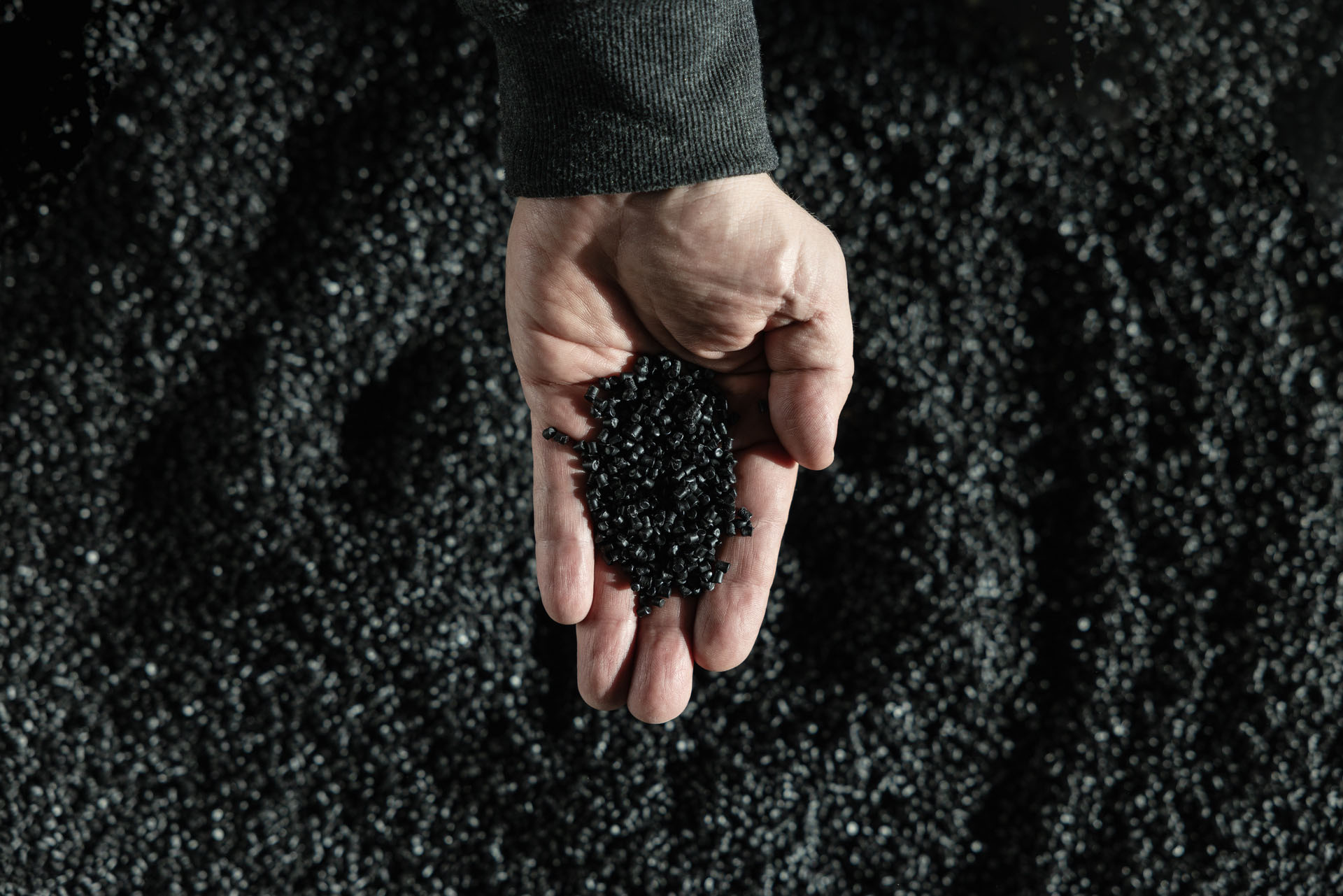
The most direct path to compliance with the recycled content targets is using verified post-consumer recycled plastic pellets. Advanced PCR materials are produced from rigorously sorted and processed post-consumer waste. They can now meet the quality and consistency standards required for technical automotive applications. This includes applications where recycled materials were previously not considered viable.
Natural fibre-reinforced biocomposites
Biocomposite materials offer a more nuanced value proposition for automotive manufacturers. Where a biocomposite is produced with a recycled plastic matrix, the recycled polymer content can contribute to an OEM’s recycled content calculation under the Regulation.
Beyond compliance, natural fibre-reinforced biocomposites bring performance characteristics that unfilled recycled polymers cannot match on their own. Natural fibre reinforcement improves stiffness and reduces part weight. It also delivers a lower CO₂ footprint than glass fibre or mineral-filled alternatives. It can also replace technical polymers such as ABS and PC/ABS, which have a significantly higher carbon footprint. For structural and semi-structural automotive components, biocomposites offer a technically credible alternative. They are more than a compliance tool.
Building Supply Chain Resilience Ahead of the Deadlines
The recycled content targets introduced by the ELV Regulation are designed to stimulate demand for high-quality recycled plastic materials and reinforce the economics of automotive recycling systems. That demand will need to be met by a supply chain that does not yet fully exist at scale.
For OEM manufacturers and compounders, the more reliable path is to begin building verified, traceable supply relationships now, before the competition for compliant material volumes intensifies.
The ELV Regulation sets the direction, and the materials capable of supporting compliance strategies are already on the market. The question is whether supply chains are in place when the deadlines arrive.
How Syklo Supports ELV Compliance
Syklo works with OEM manufacturers and compounders to build the verified, traceable material supply that ELV compliance requires. Two materials are central to that work.
Sykloplast, Syklo’s range of post-consumer recycled plastic pellets, is produced using patented sorting and processing technology. The result is a PCR material with high and consistent mechanical properties and the processability required for technical applications. Syklo supports compounders and OEMs in qualifying Sykloplast for their specific applications, from initial material testing through to series supply.
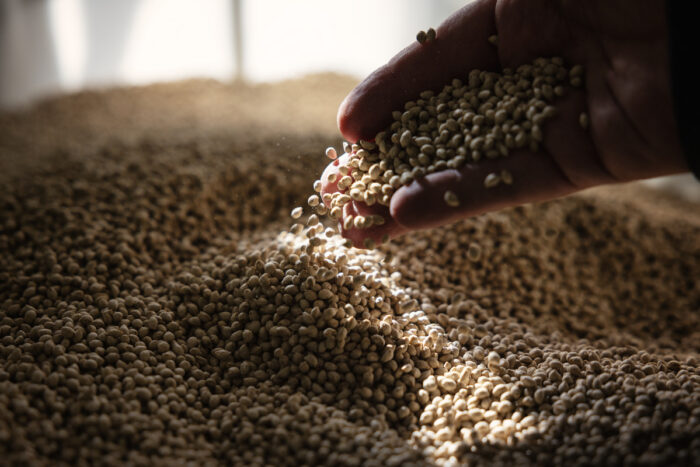
Syklocomp, Syklo’s natural fibre-reinforced biocomposite, provides stiffness and weight reduction characteristics that standard recycled plastics cannot deliver on their own. Syklocomp can be produced with a recycled plastic matrix. In those cases, the recycled polymer content may contribute to an OEM’s recycled content calculation under the Regulation. Syklocomp is also produced using Syklo’s patented wet-web technology, which preserves cellulose fibre length and maximises reinforcement performance.
Both materials are produced at Syklo’s circular economy hub in Hyvinkää, Finland, a facility combining advanced plastic recycling and manufacturing of recycled plastic pellets and biocomposite. Are you assessing how to meet the recycled-content targets? Or testing materials for a specific application? We’re happy to discuss the options.
Read more
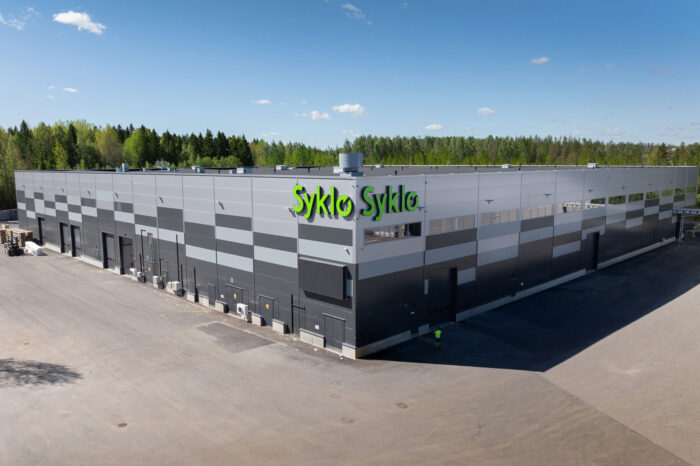
Syklo’s factory complex unique on a world scale will produce high-quality recycled plastic pellets and biocomposite
Syklo at Fakuma 2026: Explore Our Circular Economy Materials